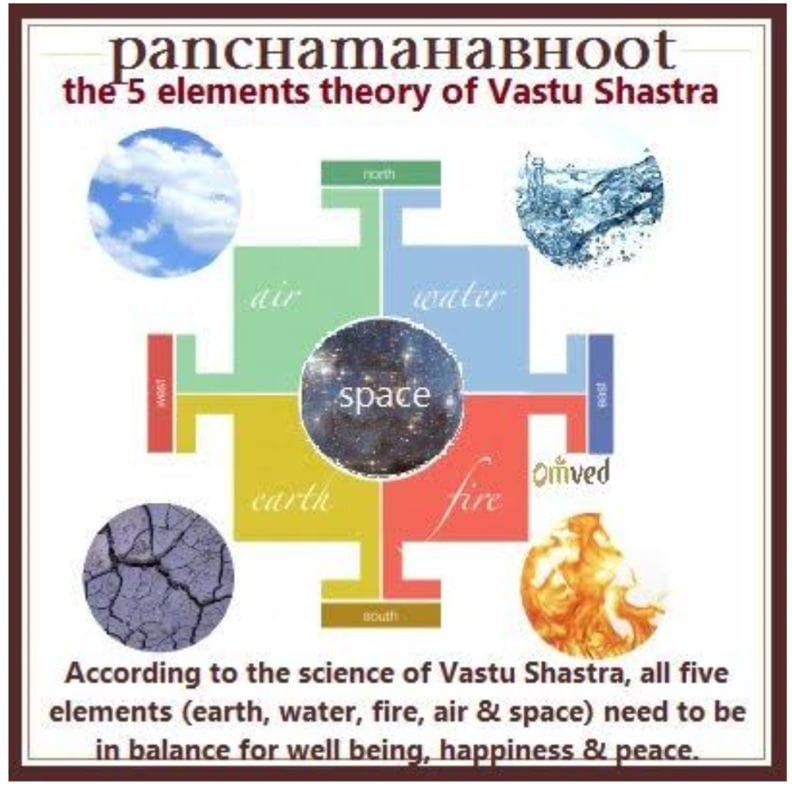
Vastu Shastra is an ancient Indian science of architecture and design that focuses on the harmony between human life and the natural environment. It is the art and science of creating spaces that promote positive energy, health, success, and prosperity. Derived from the Sanskrit words “Vastu” (meaning structure or dwelling) and “Shastra” (meaning knowledge or science), Vastu principles are based on aligning the elements of nature earth, water, fire, air, and space with human life.
In essence, Vastu is about creating spaces that are in tune with the natural energies of the environment to foster a sense of well-being and balance.
The origins of Vastu Shastra date back thousands of years to ancient Indian texts and scriptures, particularly the Vedas—the oldest sacred texts of Hinduism. The principles of Vastu are first mentioned in the Rig Veda, and over time, detailed descriptions of architectural planning and the placement of elements emerged in texts like:
The other important books of Vedic Vastu include Vishwakarma Prakash, Samrangan Sutradhar, Mayamattam, Aprajait Pruthha etc. In ancient times, Vastu was considered a sacred science, linked to cosmic and spiritual energies. Structures like temples, homes, and palaces were meticulously designed according to Vastu principles, ensuring alignment with celestial bodies, the sun, and the wind, as well as promoting peace and prosperity in the lives of the inhabitants.
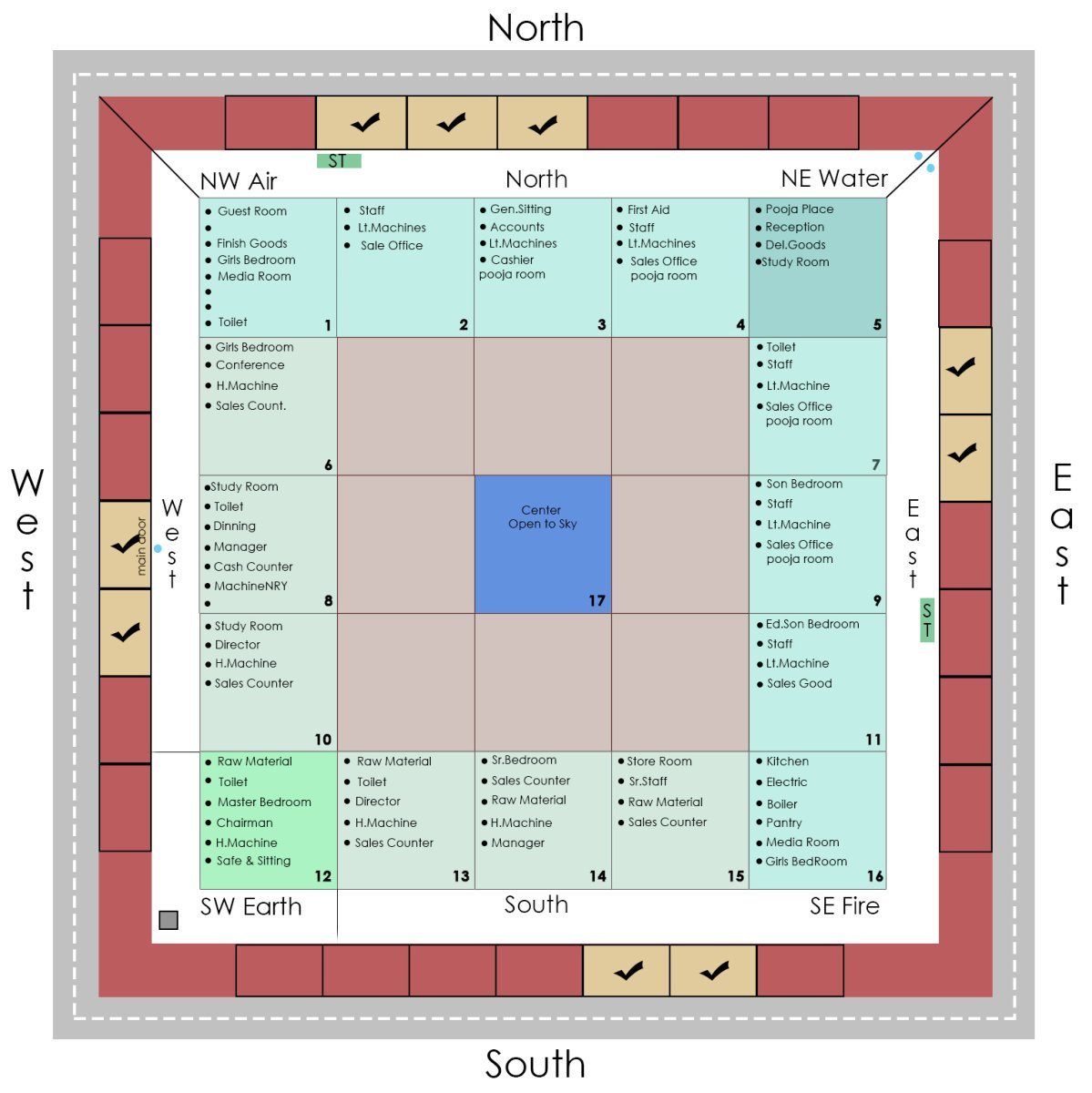
Vastu helps create balanced environments by considering the natural elements and energy flows within a space. A well-balanced space fosters mental peace, physical health, and emotional well-being.
Vastu takes into account how different directions (North, South, East, West) interact with the natural forces (sunlight, wind, magnetic fields). Proper alignment optimizes energy flow, promoting good fortune and prosperity.
Following Vastu principles can help remove obstacles, reduce stress, and enhance happiness, health, and success in both personal and professional spheres.
Spaces that are not designed according to Vastu may result in stagnation of energy, leading to financial struggles, poor health, and other negative outcomes. Vastu remedies correct these imbalances.
In Vastu Shastra, the concept of Vastu Purush holds a central place. It is a symbolic representation of the spirit or energy that governs the land or the environment where a building or structure is situated. Understanding Vastu Purush is fundamental to understanding how Vastu works in creating harmonious and prosperous spaces.
Vastu Purush is considered the deity or the “spirit of the land” who resides in every plot or property. The term “Vastu” means space or structure, and “Purush” means person or energy. The Vastu Purush represents the essence of the plot and its energy, overseeing the flow of positive or negative energy that will influence the inhabitants.
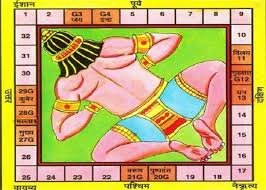
Vastu Purush is considered the deity or the “spirit of the land” who resides in every plot or property. The term “Vastu” means space or structure, and “Purush” means person or energy. The Vastu Purush represents the essence of the plot and its energy, overseeing the flow of positive or negative energy that will influence the inhabitants.
Once, there was a battle between the gods and the demons. The gods, seeking to create a peaceful and prosperous universe, invoked the power of Brahma, the creator of the world.
In this cosmic battle, Vastu Purush, a divine being, was created by Brahma to help maintain harmony and order on the Earth. Vastu Purush was said to be a gigantic figure, whose body covered the land.
As Vastu Purush grew, he became so large that he began to disturb the cosmic balance. The gods, in an effort to keep him under control, pinned him down to the Earth using the divine powers of Indra and other celestial beings.
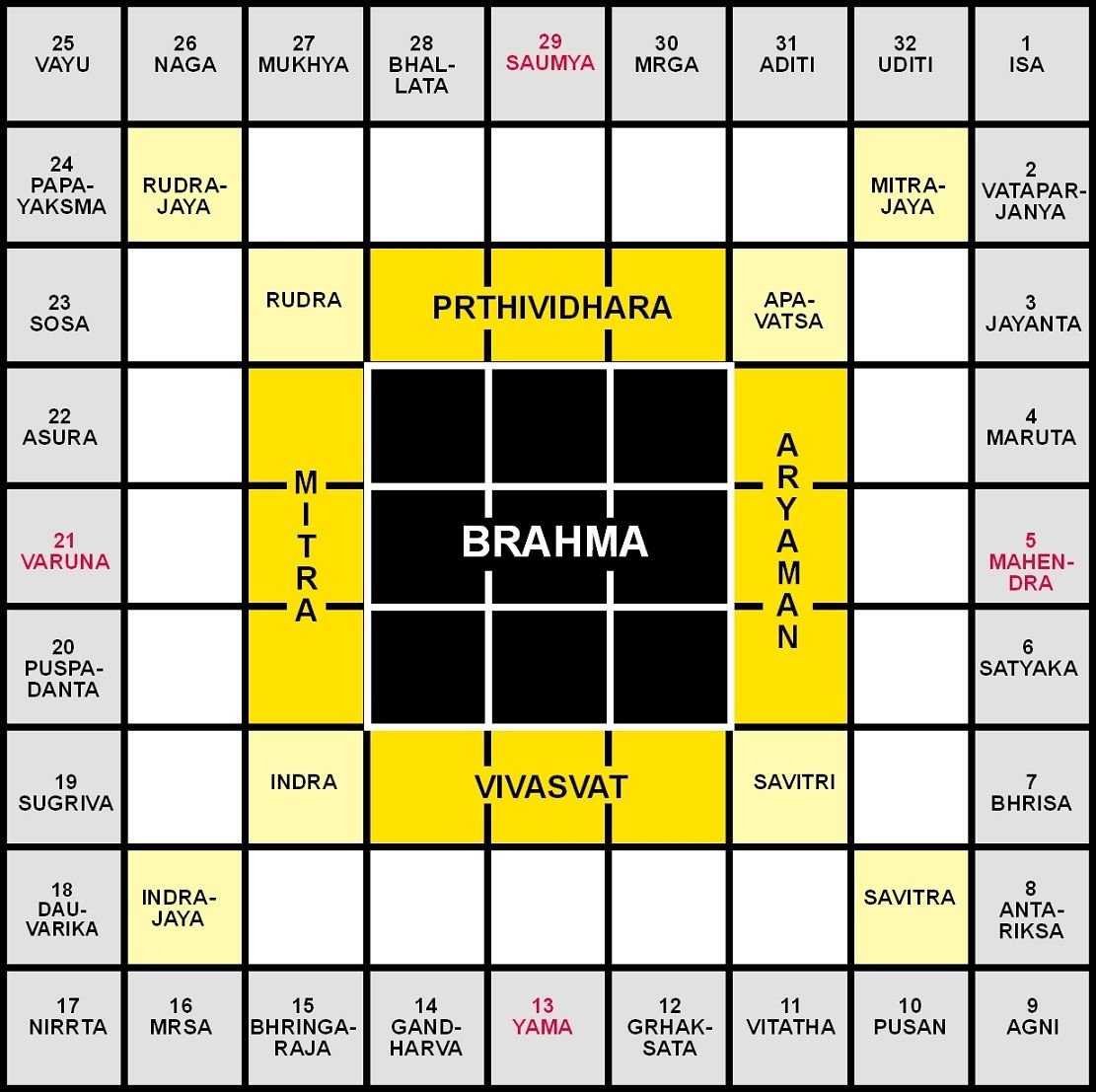
As Vastu Purush was pinned to the Earth, his body formed the Vastu Purush Mandala (the energy grid of the land). His head is said to be in the northeast (Ishan), the most auspicious zone for spiritual energy, while his feet are in the southwest (Nairutya), the area of stability.
The Vastu Purush Mandala is a 9×9 grid (81 squares) in which the body of Vastu Purush is symbolically mapped to represent the different directions and zones within a building or plot.
The head of Vastu Purush lies in the northeast direction (Ishan), which is considered the most auspicious and spiritually beneficial area of a space. This direction is linked to knowledge, wisdom, and prosperity. It is ideal for prayer rooms, temples, or meditation areas.
The east and west areas represent the arms of Vastu Purush, which are associated with communication, intellect, and relationships. These areas should ideally be kept open and free of clutter to promote healthy interactions and flow of energy.
The southwest direction (Nairutya) represents the feet of Vastu Purush. This is a direction that signifies stability, support, and grounding. It is the best area for placing the master bedroom or for foundational structures, as it is believed to provide strength and security to the residents.
The central zone (Brahmasthan) of the Vastu Purush Mandala is where the energy flow of the entire structure converges. It is the heart of the space, and it must be kept clean, open, and clutter-free to ensure that positive energy circulates properly throughout the property.
In Vastu Shastra, the layout of a building or plot is designed to respect and align with the flow of energy represented by Vastu Purush. The physical orientation, as well as the positioning of rooms and spaces, should align with the directions and energies associated with the body of Vastu Purush to create a harmonious environment.
In Vastu Shastra, energy plays a crucial role in shaping the life experience of individuals. Just as the energy of a person influences their surroundings, the energy of a space deeply affects the people living or working within it. The purpose of Energy Assessment in Vastu is to evaluate how well a space interacts with the natural elements and the cosmic forces surrounding it. This assessment helps ensure that the energy flows smoothly, positively, and harmoniously throughout the environment
In Vastu Shastra, the Five Elements—known as Pancha Mahabhutas—are central to both the design and energy of a space. These elements are:
In conclusion, energy assessment and management in Vastu ensures that the five elements are in proper balance, creating a space that promotes harmony, health, and success. By aligning these elements correctly, you can enhance your life’s overall well-being, growth, and happiness.